













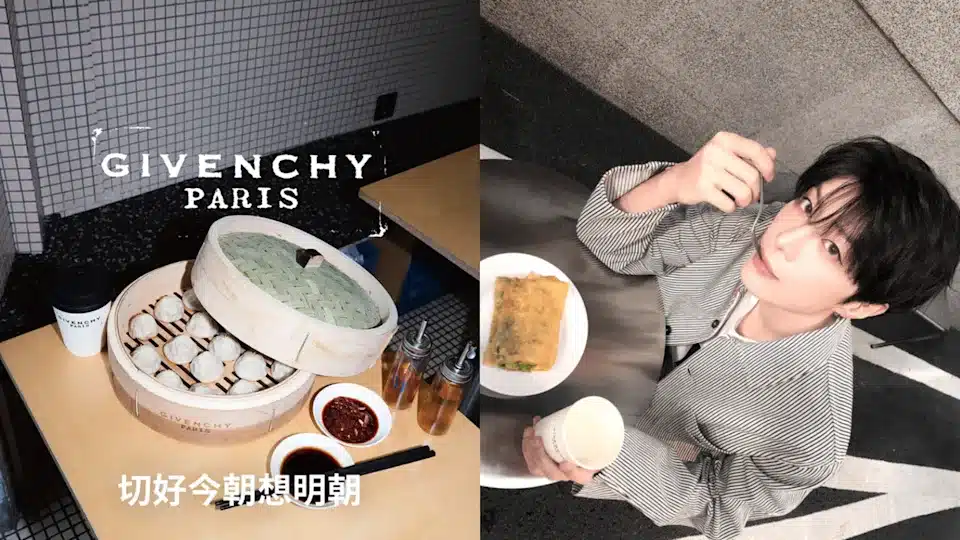
In response to a cooling economic climate in China, luxury labels are increasingly turning to unconventional, localized activations to maintain consumer interest. However, a recent breakfast-themed takeover in Shanghai by Givenchy has highlighted the delicate balance between brand accessibility and maintaining high-fashion prestige. The event, which transformed local eateries into branded experiences, has sparked a heated debate regarding cultural relevance and brand dilution.
Givenchy’s Takeover of Shanghai’s Traditional Breakfast Scene
Over a recent weekend, the French fashion house occupied three traditional Shanghainese breakfast spots and a local nightclub. The activation featured the “Four Heavenly Delicacies” of local morning cuisine: fried dough sticks, sticky rice wraps, savory soy milk, and crispy pancakes. To further bridge the gap between East and West, the menu included xiaolongbao (steamed dumplings), Chinese-style wraps, and Americano coffees.
With items priced between 3 and 38 renminbi (approximately $0.40 to $5.30 USD), the pop-up initially garnered praise for its “down-to-earth” approach. Social media platforms like Xiaohongshu were flooded with posts from users celebrating the rare opportunity to engage with a luxury brand at a fraction of the usual cost. Influencers, including Nicky Cheung, shared photos of the branded xiaolongbao, suggesting that the simplicity of local comfort food provided a “genuine energy” that resonated with the city’s lifestyle.
Criticism Over Cultural Connection and Brand Misalignment
The initial excitement quickly faced a reality check as logistical issues and conceptual critiques surfaced. Long queues in the humid Shanghai heat led to frustration, but the more significant backlash centered on the perceived lack of a meaningful link between Givenchy’s heritage and the local food culture. While Givenchy promoted the event on WeChat under the title “Breakfast at Givenchy”—an intentional nod to the iconic Givenchy black dress worn by Audrey Hepburn in Breakfast at Tiffany’s—the nuance appeared to be lost on many participants.
Local critics and creative directors expressed skepticism over the strategy. On Xiaohongshu, food critic Mozhijie argued that the campaign offered a “glossed-over version” of Shanghai that provided only temporary satisfaction for middle-class consumers. Meanwhile, Shanghai-based creative director Alex Slavycz criticized the move as a lack of cultural relevance, suggesting that luxury brands often lose their way by simply placing logos on local staples rather than focusing on desirable product design.
The Evolution of Luxury Pop-Ups in the Chinese Market
Givenchy is not alone in its attempt to weave luxury into the fabric of daily life in China. In recent years, several high-end houses have experimented with similar “lifestyle touchpoints”:
- Prada: In 2021, the brand wrapped a local wet market in its signature jacquard prints.
- Fendi: Collaborated with the popular beverage chain Heytea in 2023 for a limited-edition bubble tea.
- Loewe: Partnered with Hello Bike to launch customized gold bicycles to celebrate a new flagship opening.
These collaborations aim to foster community engagement, yet they also run the risk of alienating the core elite clientele who value exclusivity above all else.
Strategic Challenges and Brand Equity Dilution
Deya Xu, an associate professor of media studies at East China Normal University, notes that Givenchy’s latest controversy points to a deeper issue: the tension between the need for sales volume and the preservation of brand equity. As the Chinese economy slows, luxury brands are caught in a difficult position. They must attract new, aspirational shoppers who might only purchase a single accessory every few years, yet doing so can diminish the “luxury” aura for high-net-worth individuals.
Furthermore, Givenchy’s retail footprint in China is currently in flux. The brand has recently exited several prominent locations, including Shanghai’s Plaza 66 and Reel Department Store, as well as malls in Changsha and Tianjin. This retreat suggests a strategic consolidation as the label moves away from the rapid expansion seen in previous decades, including the scaling back of its diffusion line, G Givenchy.
Final Thoughts on the Future of Localized Luxury Marketing
The “Breakfast at Givenchy” activation serves as a case study for the complexities of modern luxury marketing in China. While the intention was to pay homage to a cinematic classic through a local lens, the execution revealed a gap between brand storytelling and consumer perception. For luxury houses to succeed in an increasingly discerning market, the focus may need to shift from temporary, logo-heavy social media moments back to consistent product innovation and more deeply integrated cultural narratives that justify their premium status.