















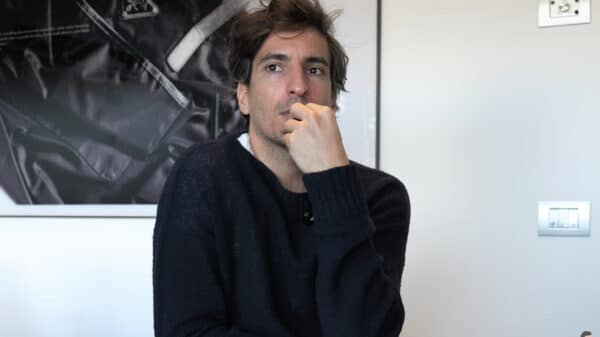


Seán McGirr, the notable creative director of Alexander McQueen, has deep roots in Asia, where his fashion career commenced over a decade ago. His journey began in Japan, taking an internship at Vogue Homme, followed by a design role at Uniqlo, laying the foundation for his impressive career in fashion.
During this formative period in Japan, McGirr also made his first visit to China, an experience that left a lasting impression on him.
He reminisces about the vibrant energy of the city, particularly the pulsating hip-hop scene in Shanghai that defined his initial impressions.
Years later, upon returning to Shanghai, McGirr noted a significant shift in the city’s atmosphere. “It’s more subdued now, probably due to the rise of electric vehicles,” he observed. His recent visit included stops at historical sites like the Jinjiang Hotel and the serene waterfront along Suzhou Creek, showcasing the evolving local nightlife, including the trendy C Park club hub.
This trip coincided with McQueen’s “Beneath the Surface” event, celebrating the brand’s Fall 2026 collection with an exhibition hosted at Fotografiska Shanghai.
“It’s thrilling to be here, reflecting on the intersection of culture and fashion,” said McGirr. He expressed a curiosity about how McQueen resonates with audiences in diverse locales such as China, South Korea, and Mexico. “This prompts me to contemplate the themes of unconventional beauty that have always fascinated me about McQueen since my teenage years,” he added. He fondly recalled purchasing his first McQueen skull scarf, which captured the spirit of indie culture during his youth.
During discussions about McQueen’s identity, McGirr pointed out an intriguing connection between the brand and Kasing Lung, creator of the Labubu character, who has drawn comparisons between his work and animations by Tim Burton. “Burton, who previously collaborated with Alexander McQueen in 2002, had a profound impact on the brand’s aesthetic, blending dark romance with whimsy,” McGirr noted.
McGirr appreciates this intertwining of horror and humor, particularly in the popular skull scarves, which he describes as having a playful essence.
At McQueen, McGirr utilizes an intense focus on product development—a skill he honed during his time at Uniqlo—to cultivate his design philosophy. He emphasized the lessons learned in Japan, particularly about creating functional yet stylish wardrobes. “My aim was to design the ideal shirt, often inspired by historical uniforms, emphasizing practicality while adhering to modern aesthetics,” he explained.
At McQueen, McGirr applies a more intuitive approach to design, characterized by an instinctive “sense checking.”
“I don’t follow a strict formula; it’s about how one feels in the moment,” he explained. To this end, he engages in weekly psychoanalysis, which helps him adopt a critical perspective toward his work.
During his visit to Shanghai, McGirr spoke at Donghua University, sharing insights about his design philosophy with graduating fashion students. He encouraged them to focus on grassroots research and to take a break from their screens to discover their authentic voices in the industry.
In addition to discussing his creative vision at McQueen, he revealed that the inspiration for the current collection was significantly influenced by Todd Haynes’ film “Safe,” which explores themes of safety and claustrophobia. “There’s an undertone of liberation that eventually emerges,” he reflected.
McGirr aims for silhouettes that cocoon the body while varying concepts and narratives to keep the creative process exciting for both him and his team. “McQueen is a unique brand, not designed for mass consumption, which adds to its allure,” he stated.
To culminate his Shanghai visit, McGirr interacted with VIP clients during an intimate collection viewing, and he also connected with designers involved in Kering’s new initiative, CRAFT, promoting collaboration between artisanship, fashion, and technology.
In conclusion, Seán McGirr’s journey through fashion—from his early days in Japan to his pivotal role at McQueen—highlights the importance of cultural awareness in design, as well as the value of personal introspection. His commitment to merging traditional craft with modern aesthetics reflects the evolution of fashion in an ever-globalizing world.