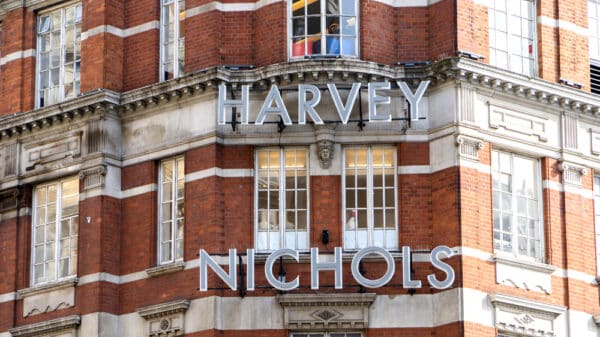











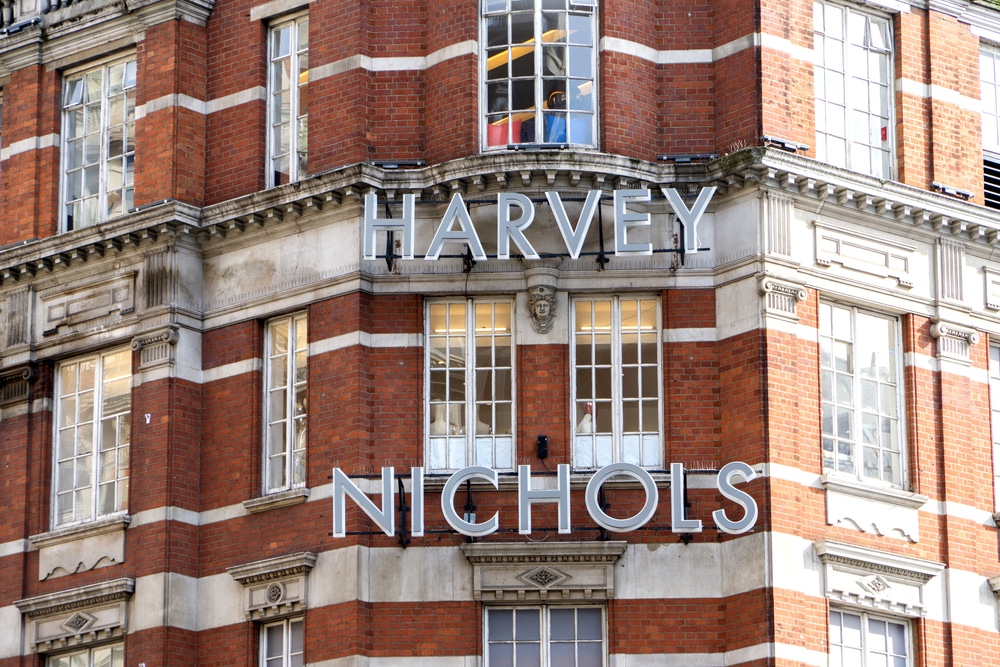
LONDON — Harvey Nichols’ brands and suppliers have been stuck with millions of pounds in unpaid invoices following the store’s collapse into administration and quick purchase by Mike Ashley’s Frasers Group last month.
According to a lengthy filing on Companies House, the official business register in the U.K., administrator FTI Consulting could pay 13.2 pence for every pound owed to unsecured creditors, according to the latest financial report. Estimated unsecured creditor claims total 270.5 million pounds.
In its filing, FTI also confirmed that it sold nearly all of Harvey Nichols’ U.K. businesses and assets for 43.3 million pounds. Separately, it offloaded the Oxo Tower Restaurant, Bar and Brasserie for 900,000 pounds to a private group of London restaurateurs.
Harvey Nichols owes millions of pounds to hundreds of brands ranging from Ralph Lauren U.K. and Chanel to LaDoubleJ and Casablanca. It’s also in hock to lawyers, banks, software companies, the city councils where Harvey Nichols has stores, and HMRC, His Majesty’s Revenue and Customs tax office.
FTI also revealed the details of the Harvey Nichols sale and administration process, and its plans to wrap up the company before Frasers officially takes over.
Harvey Nichols was the subject of a “pre-pack administration,” where the sale of a business is agreed upon prior to the administrator being formally appointed.
The decision to “pre-pack” often stirs up controversy here. Creditors don’t like it because they have little visibility on the process until the deal is done, but ailing businesses see it as a swift and efficient way to resolve their problems and execute a swift sale.

Chloé, fall 2026
Courtesy of Chloé
Buyers like a pre-pack because it allows them to shed debt quickly, reshape the company or shut it down completely.
According to FTI’s filing, Chloé, Canada Goose and Ralph Lauren U.K. are among the biggest brand creditors. Each is owed between 450,000 pounds and 600,000 pounds.
Brunello Cucinelli, Deckers U.K., Joseph, Kering Eyewear, Khaite, Yves Saint Laurent, Max Mara and Victoria Beckham are each owed in excess of 300,000 pounds, while Charlotte Tilbury, Jacquemus, Skims, Stella McCartney, Tory Burch and Zimmerman each have unsettled payments of more than 200,000 pounds.
Creditors with up to 150,000 pounds in outstanding payments include Acne, Alaīa, LaDoubleJ, Hugo Boss, Casablanca and Chanel.
FTI clarified that the proposed payout percentages were not final, and dependent on “future realizations, administration costs and the level of admitted creditor claims.” It said estimates are subject to change and should be treated “with an appropriate degree of caution.”
Harvey Nichols’ administration comes at a tricky time for brands, which are still feeling repercussions from the collapse of Matches in 2024 and Saks Global earlier this year.
This is the third time in three years that brands will find themselves out of pocket due to the wind-down of a heritage retailer. The decline of the wholesale channel overall has been a blow to the industry’s morale and its balance sheets and forced many brands to put a greater emphasis on direct-to-consumer sales.
There are more challenges in store for Harvey Nichols.
Shortly after it purchased Harvey Nichols, in a deal that included the Knightsbridge flagship, five regional U.K. stores, the international franchises and the online business, Frasers said there was significant potential in the retailer, although “meaningful change is needed.”
The company added it is planning a “significant restructuring and integration of Harvey Nichols into the Frasers Group ecosystem … to create a sustainable business for the future, including a review and rationalization of the store portfolio, organizational structure, operating model and cost base.”
It later made a goodwill gesture to the personal shoppers and stylists who were owed money for work done under Harvey Nichols’ previous ownership before the department store entered administration.
“Whilst this would normally be a matter for the administrator with no obligation falling upon Frasers Group, we would like to reassure these individuals that we will ensure they are paid swiftly and in full,” a spokesperson said, adding that the company aims “to be supportive of individual traders and small businesses.”
From now on, Harvey Nichols’ personal shoppers and stylists will be paid monthly rather than quarterly.
Once one of London’s hottest retailers with a starring role in the 1990s television hit “Absolutely Fabulous,” and a trend-setting beauty offer, Harvey Nichols fell victim to under-investment by its former owner Dickson Poon.
The loss-making store was also hit hard by the cancellation of tax-free shopping in the U.K., flagging demand for luxury goods and competition from its neighbors, Harrods and Selfridges which, until now, have invested far more aggressively in their store estates.
Harvey Nichols said it does not comment on market speculation. Reports of a potential sale were first published by Sky News late last month.
In a statement, Harvey Nichols said it remains “fully focused” on delivering its transformation strategy. “We are making strong progress across the business, including a complete refurbishment of our flagship store in Knightsbridge, which is showing positive early signs of growth and reinforces our confidence in the direction of the business,” the statement added.The ground floor space known as “125” was the first to be unveiled as part of a multiyear refurbishment of the store. Courtesy
Last fall Harvey Nichols unveiled phase one of its transformation, a ground-floor concept space known as “125,” after its Knightsbridge address.Designed by Sybarite architects, and with installations by Gary Card, the space has floor-to-ceiling windows facing Sloane Street, at the corner of Knightsbridge. It stocks jewelry, homeware, gift items and books. There are also dedicated spaces for pop-up concepts and the Japanese coffee shop Kuro Coffee. As part of the three-year refurbishment, Harvey Nichols has also transformed its fourth floor into a wellness space with a 360-degree offer.
There is a Pilates studio; a dedicated clinic for aesthetic and therapeutic beauty services, and a Smoov bar, which serves functional drinks and vitamin supplements. The floor also includes the first physical space for the Healf, the wellness platform, and an athleisure department with brands including Vuori, Tala, Literary Sport, Adidas and New Balance. The fifth floor is undergoing refurbishment, with plans for a new restaurant and other hospitality spaces.
Goddard told NewInFashion earlier this year her aim is to bring back the “glory days” of the store in the 1990s and 2000s, and to focus on the well-heeled local customer. She has been working to upgrade all aspects of the store, from fashion to beauty to lifestyle.
The new Pilates in the Clouds studio at Harvey Nichols. Courtesy

The new Pilates in the Clouds studio at Harvey Nichols.
Courtesy
It’s not just the store that’s moving on.
Poon, the Hong Kong-based billionaire businessman and philanthropist, stepped down as a director of Harvey Nichols in May and has also given up his other European directorships, according to Companies House, the official U.K. business register.
Poon purchased Harvey Nichols in 1991 for 53 million pounds through his company, Dickson Concepts International, and quickly began rolling out stores across the U.K. A few years later, he floated the retailer on the London Stock Exchange only to take it back into private hands in 2003, citing macroeconomic pressures.
In the first decade of his ownership, he invested heavily in updating the London flagship with new departments, such as restaurants and a food hall, and services and tapped into the growing British demand for fashion, beauty and fine foods. The store — known affectionately as “Harvey Nicks” — became a household name on both sides of the Atlantic following the success of the BBC TV comedy series “Absolutely Fabulous.”
The show starred Jennifer Saunders and Joanna Lumley as two hard-partying fashionistas, one a PR, the other a glossy magazine editor, who chugged Bollinger Champagne, known as “Bolly,” and regularly nipped to Harvey Nicks to buy their high-end designer duds.
Over the years the store built a reputation as a beauty powerhouse under Daniela Rinaldi, who rose to become co-chief operating officer before leaving the company in 2019.
She launched brands ranging from MAC Cosmetics to Shu Uemura to Fenty Beauty in the U.K. — and oversaw the store’s evolution into a multichannel — and multiservice — business. The exclusive Fenty launch in 2017 was such a success that for months afterward, Harvey Nichols had to place velvet ropes outside the entrance to keep the crowds in check.But like most fashion retailers, Harvey Nichols has had its ups and downs, and was most recently hit hard by the cancellation of tax-free shopping in the U.K., flagging demand for luxury goods and competition from its neighbors, Harrods and Selfridges which, until now, have invested far more aggressively in their store estates.
Kate Phelan Courtesy Photo
According to the most recent filings on Companies House, revenue in fiscal 2024 fell 5 percent to 205 million pounds, while losses widened to 34 million pounds from 21 million pounds.
Founded in 1831, Harvey Nichols employs around 1,200 people in the U.K. and has stores in London, Leeds, Edinburgh, Manchester, Birmingham, Bristol and Dublin. It also operates the OXO Tower Restaurant, Bar & Brasserie on London’s South Bank and the global harveynichols.com website.
Internationally, Harvey Nichols has franchise stores in Hong Kong, Dubai, Riyadh, Kuwait and Doha.