
















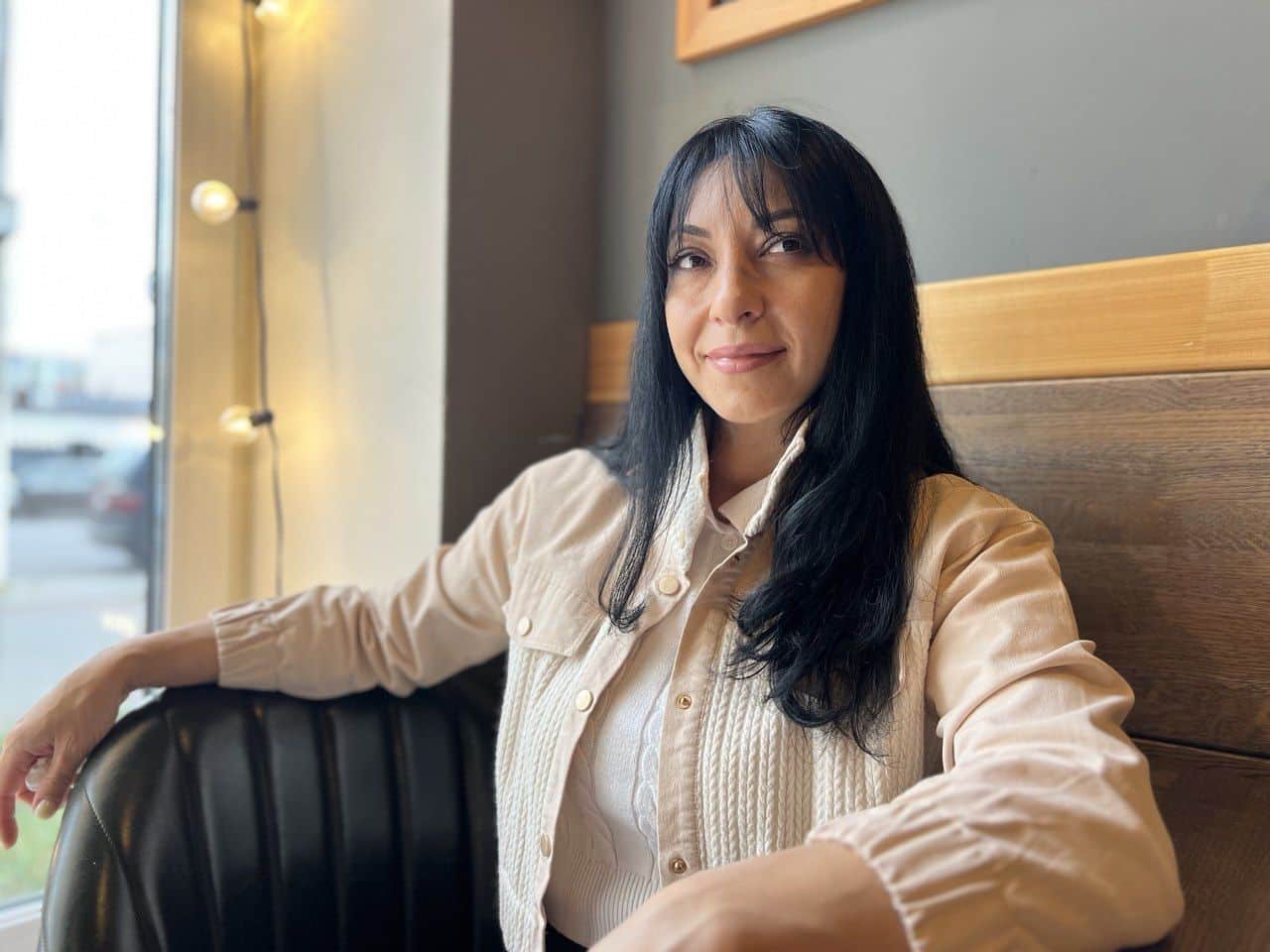
On January 8, 2025, the UK Parliament held the second reading of the Children’s Wellbeing and Schools Bill. The law will require schools in England to limit uniforms to no more than three compulsory branded items – four for older students, if one of them is a tie. The country that invented the school uniform as a category is now arguing over how much branding it actually needs. In Belarus, designer Elnara Karabanova is arguing about something else entirely: how much individuality is allowed in clothes everyone has to wear. Her brand, MANIYA, keeps expanding its uniform line, adding sizes for larger children and pushing further into major online marketplaces.
Karabanova’s law degree sat unused for years before she admitted the career she’d trained for held no real interest for her. In 2004, with permits secured through a state subsidy program, she opened a bridal shop – rental gowns, accessories, full-service wedding styling. A chain of stores followed. In 2010 came her own atelier, offering custom-made formal wear. Not long after, children’s party dresses started showing up alongside the bridal line.
The real turning point came from her own customers. “Parents who came to me for party dresses would ask: can you make a school dress too? A pinafore? A blazer that actually fits a kid properly? I started experimenting, and pretty quickly realized I found it more interesting than formal wear,” Karabanova recalls. In 2012, she brought in industrial sewing equipment and hired qualified tailors – and the first uniform collection was born.
There’s something almost counterintuitive about the shift. She traded a category that rewards creative freedom for one that punishes it. “With an evening gown or a wedding dress, a designer gets away with a lot for the sake of effect. You wear it for a few hours. A school uniform gets worn five days a week, six to eight hours a day. The kid sits in it, runs up stairs in it, takes a backpack on and off. A pretty sketch guarantees you nothing,” she explains. Uniforms, she says, were where she first felt like a designer rather than someone who sews nice things. Once decoration can’t solve the problem, she has to pay real attention to proportion, shoulder line, fit, fabric.
She has a much blunter test for whether something works: the child should stop noticing it. “If a girl keeps tugging at her skirt, adjusting her waistband, complaining that the collar chafes or the sleeve gets in the way when she writes – the piece doesn’t work.” That’s why she watches a garment in motion, not in a mirror. “Something can look perfect in the mirror and completely fall apart the moment a kid starts moving.”
She doesn’t see constraints as a problem – with a catch. “I honestly think total creative freedom is a little overrated. When someone says: here’s navy blue, here’s what the school requires, here’s a kid who needs to be comfortable, now make it recognizable – that’s when the real work starts.” There’s a limit, though. If a school dictates skirt length down to the centimeter and allows exactly one blazer style, there’s not much left for a designer to do. She’s more interested in systems that share a visual language but still leave room to choose within it.
Her answer to the biggest complaint about uniforms – that they erase a child’s individuality – grows out of exactly that room for choice. Karabanova only half agrees with the criticism. “A badly made uniform really does erase individuality, because it’s built around some idea of an average kid. But kids aren’t average.” Her formula is simple: the school sets the visual code, and the designer offers several ways to exist inside it. Same color doesn’t have to mean the same silhouette.
That thinking shows up most clearly in MANIYA’s decision to design separate models for larger children. The push came from conversations with mothers. “I kept hearing almost the exact same phrase: ‘There’s nothing normal for her to wear.’ And the word ‘normal’ really bothered me.” Simply scaling up the base pattern didn’t work – proportions shift, so the armhole, waist, and front-to-back balance all needed rethinking. Karabanova drew a clear line for herself here. “It matters a lot to me not to slide into ‘let’s just hide the extra weight.’ I don’t want the clothes telling a girl there’s something wrong with her body.” The same logic, she says, explains the biggest mistake uniform manufacturers make in general: treating kids like scaled-down adults. Children’s proportions are different – and shift especially fast between ages ten and fourteen.
A separate thread in her work is Kamvol wool, made at a Belarusian mill, which she calls a genuine source of inspiration. The origin of that choice was practical, and she doesn’t dress it up: the material was close at hand, and she already knew it well. Her thinking about it has since evolved. “I like the idea that clothes made here can connect to a place without an embroidered pattern or an obvious national symbol – through the material itself instead. It’s a quieter way of talking about where something comes from.” She applies that same caution to cultural identity more broadly. “I’d use the word ‘national’ carefully. If someone looks at a MANIYA piece and says, ‘there’s something very local about this,’ even though there’s no obvious national symbol on it anywhere – that’s a far more interesting result to me.”
She takes a similar approach to school identity, with a nod to the British model, where a uniform alone can tell you which school a student attends – though she wouldn’t import that principle wholesale. “Good school branding should be recognizable without turning a kid into a walking advertisement for the institution. I’m always in favor of small details that read as insider knowledge, not a logo across half the blazer.” It’s almost word for word the argument playing out in Westminster right now.
MANIYA’s TR EAEU 007/2011 compliance certification, granted in 2023, opened the door to wholesale buyers and supply contracts with major online marketplaces. The shift to mass production changed how she approaches construction itself. “In the atelier, you can fix a piece right there on the client. In mass production, that option doesn’t exist. A pattern has to work for a large number of kids at once.” A beautiful but finicky design sometimes has to be simplified – she doesn’t count that as a designer’s defeat. “Good industrial design is when a piece, after all the manufacturing constraints, still doesn’t look like a compromise.”
Marketplaces bring their own headache: a child never tries the garment on before it’s bought, so a sizing mistake turns straight into a return.
Karabanova doesn’t frame the future of uniforms as a question of whether they should exist at all – to her, that debate is already outdated. A uniform does something ordinary clothing can’t: it visually builds a community. “The real question is whether you can make belonging to a group comfortable for someone who still wants to feel like themselves.”