

















Reflecting the wisdom of 17th-century critic Nicolas Boileau, who urged creators to “make haste slowly” and persist through frequent revision, Yohji Yamamoto’s latest menswear collection felt like a masterclass in deliberate, iterative design. For this season, the legendary designer turned his focus toward the architecture of the shoulder, treating the garment as a canvas for a series of meticulous anatomical studies reminiscent of a Renaissance artist.
The Evolution of the Silhouette
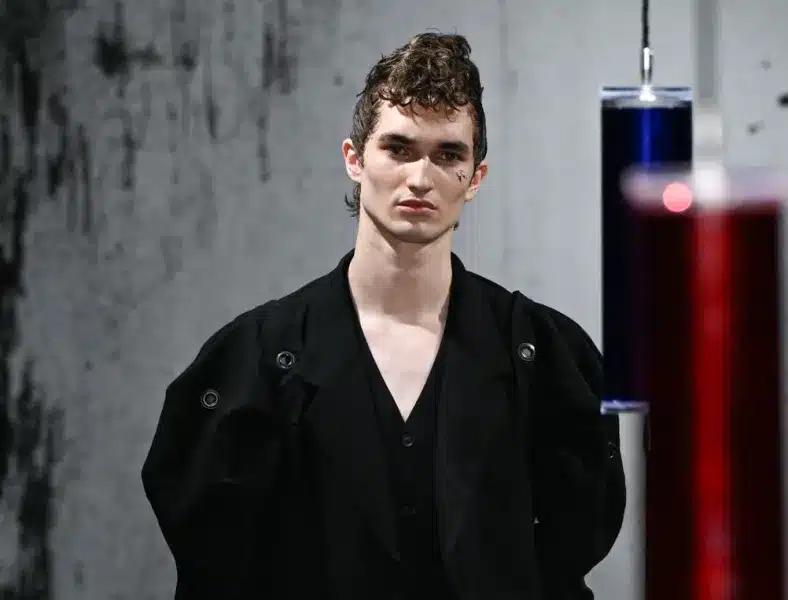
The collection opened with a series of monochromatic black ensembles that initially appeared uniform but revealed deep complexity upon closer inspection. These looks featured elongated jackets characterized by intricate pleating on the sleeves, which were fastened with industrial grommets. Paired with oversized shirts and voluminous shorts, the garments served as the foundation for a broader investigation into proportion and construction. Yamamoto played with the very concept of the sleeve, alternating between peaked, upward-jutting silhouettes and protective, cocoon-like shapes integrated with spliced inserts.
Chivalry and Historical Influence
Yamamoto’s deep understanding of historical dress was evident throughout the presentation. The collection seemed to draw direct inspiration from 19th-century aesthetics, a period that often translated the protective elements of medieval armor and chivalric ideals into civilian fashion. This historical lens transformed zoomorphic imagery and cruciform symbols into modern heraldic markers. The choice of materials further bridged the gap between the past and present; rugged black wool and raw, unbleached linen were contrasted with delicate lace and devoré velvets. Layered over printed mesh, these textures evoked the regalia of a bygone era, while metallic-flecked knits and sudden bursts of crimson served as a contemporary nod to traditional chain mail.
Poetry and the Human Element
Beyond the structural innovations, the collection carried a poignant, existential weight. Cryptic phrases were printed across the backs of several garments, referencing “inner ghosts” and a yearning for distant places. These poetic fragments suggested that while the clothing provides a physical buffer against the outside world, the most significant conflicts are often internal. This sense of individuality was mirrored in the casting, which featured a diverse array of models with lived-in features, purposefully defying conventional standards of age and gender. A notable moment occurred when jewelry designer Rie Harui, the creative force behind Yohji Yamamoto by Riefe, closed the show—a move Yamamoto described as significant for both her design expertise and her presence as a woman in his menswear narrative.
A Reflection on the Modern Condition
Addressing the current global climate, Yamamoto offered a characteristically stoic perspective. He described the present moment as a paradox of being “comfortable yet uncomfortable,” acknowledging the difficulties of the modern era while emphasizing a fundamental need for resilience. His work continues to serve as a testament to the idea that even when the path is challenging, the creative process must remain a persistent, evolving pursuit.
Summary of the Season
Yohji Yamamoto’s Spring collection is a profound exploration of protection and vulnerability. By blending 19th-century historical motifs with avant-garde tailoring, Yamamoto has created a wardrobe that acts as both armor and a means of poetic expression. The focus on the shoulder architecture, combined with a diverse casting and thoughtful materiality, reinforces his status as a designer who values the slow, deliberate craft of fashion over fleeting trends. Ultimately, the collection serves as a reminder that fashion is not just about the external silhouette, but also about the internal resilience of the wearer.